

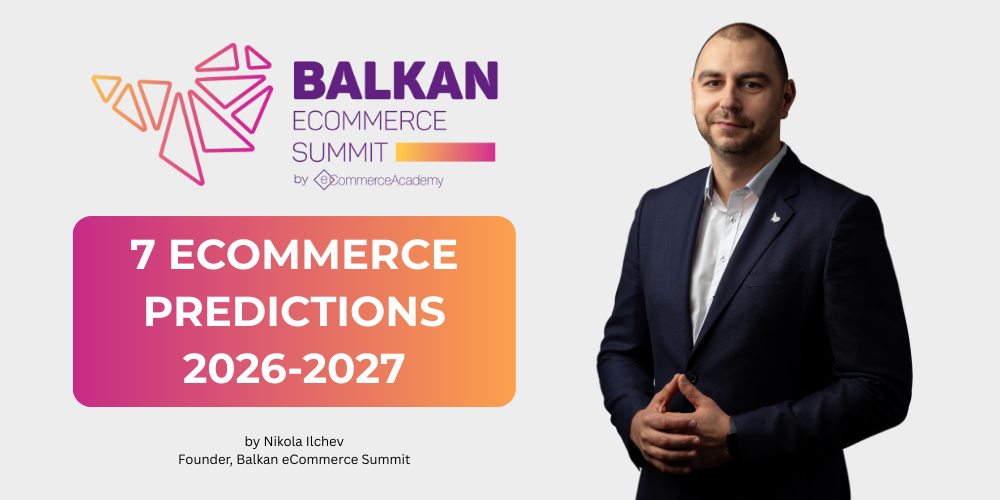
Nikola Ilchev, PhD, doesn’t make predictions from theory. For over a decade, he has worked hands-on with leading eCommerce brands across the Balkans, seeing firsthand what drives growth and what holds it back. As the founder of eCommerce Academy and Balkan eCommerce Summit, he stays in constant dialogue with CEOs, platforms, and agencies shaping the market today. What follows isn’t speculation.
These are 7 shifts already happening and they will define who accelerates and who falls behind in 2026-2027.
Balkan brands will invest more in retention than in acquisition for the first time
In the following years, many Balkan eCommerce brands will prioritize retention over acquisition. Not because it’s fashionable, but because economics will force change. Rising ad costs, platform saturation, and audience fatigue are making pure performance-driven growth harder to sustain. At the same time, too many businesses in the region are still underusing the most controllable assets they have: existing customers and first-party data.
In the coming years, we’ll see a serious shift toward CRM, email, SMS, loyalty programs, and post-purchase experience. Not as isolated tools, but as a connected system designed to increase lifetime value and repeat purchases.
Cross-border within the EU will become the default growth path, not an expansion strategy
Selling cross-border within the EU will stop being perceived as “international expansion.” It will simply become normal operating mode for eCommerce businesses. European merchants will increasingly launch multi-country stores from day one, designed to serve several markets simultaneously. With EU-wide logistics networks, localized payments, and automated VAT solutions already in place, the technical and operational barriers are no longer the real challenge.
The bigger shift will be in mindset. Brands that continue to think in single-market terms will start to look unusually conservative and limited. Growth opportunities will exist just across the border, often in markets with similar customer behavior and demand.
Cross-border selling won’t be about aggressive scaling. It will be about smart distribution, risk diversification, and building resilience across multiple markets.
Marketplaces will evolve from sales channels into brand discovery platforms
For a long time, marketplaces were treated purely as sales channels and a place to move volume, often seen by brands as a “necessary evil.” That mindset will become a serious disadvantage. Marketplaces are evolving rapidly into powerful brand discovery platforms. We’ll see much stronger brand pages, richer content formats, video-first product presentation, and more meaningful data shared with sellers. For many consumers, marketplaces are no longer just a checkout destination they are the starting point of the buying journey.
Traffic is not going away. On the contrary, marketplaces will remain one of the most dominant sources of product discovery in eCommerce. Brands that ignore this reality or invest minimally will steadily lose visibility to competitors who understand how to build a brand inside the marketplace environment.
Local heroes will outperform global giants in niche categories
Global marketplaces will remain dominant in terms of traffic and scale, but in many niche categories, local heroes will consistently outperform global giants. Categories like cosmetics, supplements, fashion, and home products are driven by trust, habit, and cultural nuance. This is where regional brands have a natural advantage. They deliver faster, communicate in the native language, understand local preferences, and build credibility through proximity, both physical and emotional.
The most successful local players won’t fight global giants head-on. They’ll coexist with them using marketplaces for reach, while winning loyalty through relevance, speed, and cultural connection.
AI will move from experimentation to operational dependency
In the following years, AI won’t be a “nice-to-have tool” anymore. It will be embedded in forecasting, demand planning, ad optimization, customer support, content creation and fraud prevention. The competitive gap will grow between companies that systemize AI and those that only “play with it.”
Nano and micro influencers will become a core growth channel
In the coming years, nano and micro influencers will stop being an “experiment” and will become a core part of every serious brand’s strategy. As consumers grow more skeptical of polished ads and celebrity endorsements, trust will continue to shift toward real people with smaller but highly engaged communities. Nano and micro influencers don’t sell attention they transfer credibility. Their audiences listen because the relationship feels personal, not transactional.
Smart brands will stop looking at influencer marketing as a branding-only channel and start integrating nano and micro creators directly into their performance, content, and community strategies. Used correctly, they become content engines, feedback loops, and even product validators.
Brand trust will become a measurable growth metric
For years, brands have been obsessed with building audiences. More followers, more reach, more impressions. In the coming years, we’ll clearly see that community will outperform audience in every meaningful business metric. An audience listens. A community participates.
And participation is what creates loyalty, trust, and long-term value.
The most resilient global eCommerce brands will deliberately shift their focus away from vanity metrics and toward building ecosystems around shared values, education, and real interaction. This includes curated events, private groups, member-only content, and direct two-way communication where customers feel heard, not targeted.
Bonus prediction: Many brand owners will try Live Shopping
Live shopping will attract a lot of attention from brand owners in the coming years. Many will try it. Some will succeed. But for most, the results will remain limited.
What we see in China often creates unrealistic expectations in Europe. The behavior, platforms, culture, and consumer habits are very different. In our region, we are still at least five years away from live shopping being perceived as a fully normal and mass online behavior.
Live shopping is not just a new sales format, it’s a combination of entertainment, trust, hosts, logistics, and impulse-driven culture. Without the right mix, it quickly turns into a high-effort, low-return activity. That doesn’t mean brands should ignore it. It means they should treat live shopping as a learning and branding tool first, not as a guaranteed revenue channel.
What’s Next?
The next two years won’t reward brands that chase every new trend. They’ll reward those that build systems – retention systems, community systems, cross-border systems.
The competitive advantage in 2026 won’t come from knowing what’s coming. It will come from being ready when it arrives.
More emerging trends and strategies shaping the next phase of Balkan eCommerce will be discussed and shaped at Balkan eCommerce Summit 2026.
Learn more at: https://balkanecommerce.com
0 comments