

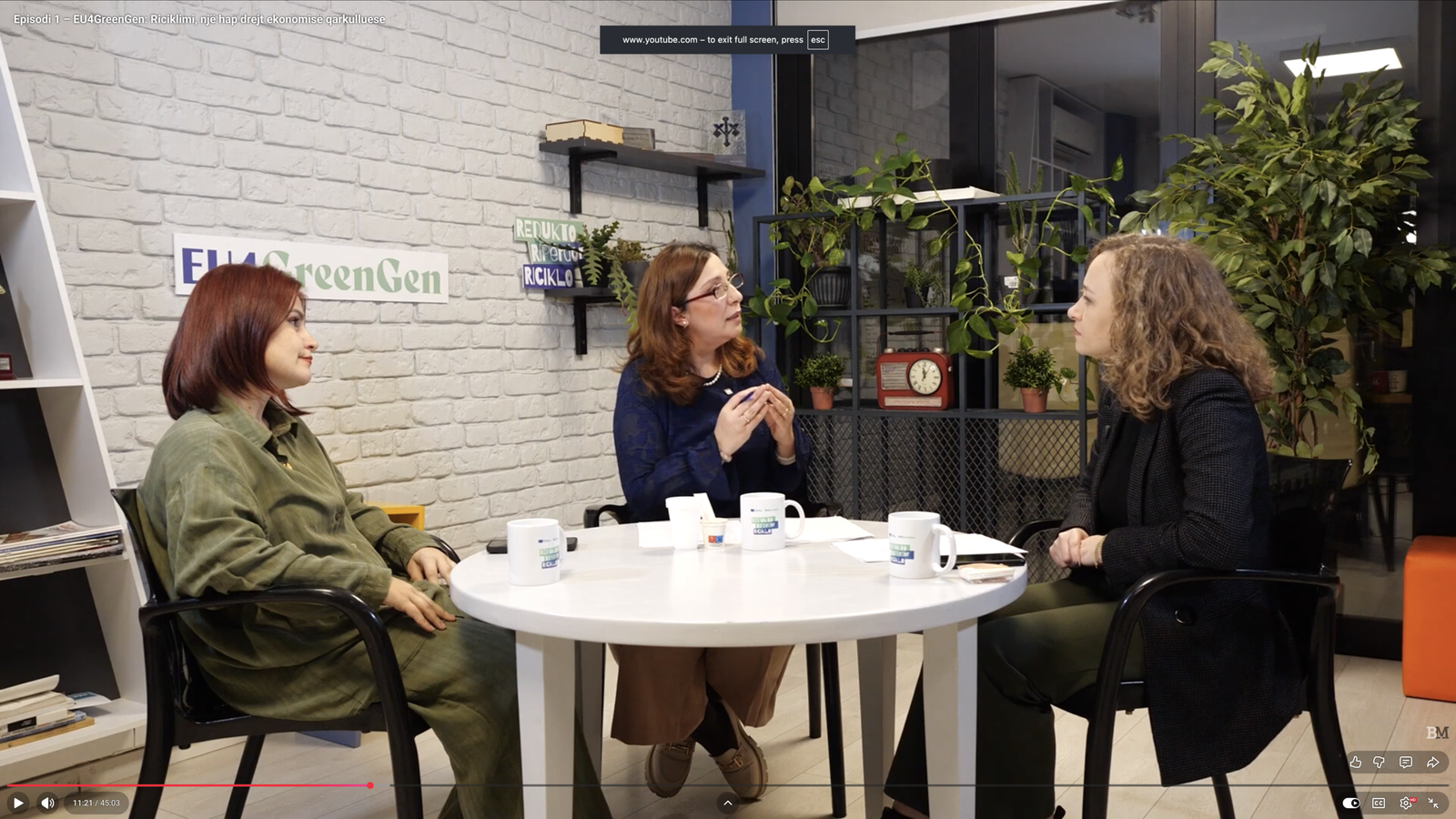
What happens when an empty jar returns to the shelf, and when a craft beer becomes the symbol of a new production philosophy? The first episode of the Green Economy podcast series focused on precisely this quiet transformation: the moment when personal choices evolve into business models and when the circular economy becomes a concrete practice.
Under the theme “Success in the Circular Economy: How Albanian Businesses Are Going Green,” the episode presented two stories that, although operating in different sectors, share the same foundation: the pursuit of quality, authenticity, and environmental responsibility.
From Personal Need to Zero-Loss Production
Marsela Gurra, founder of “Panja,” shared that her entrepreneurial journey began with a personal need for high-quality gluten-free and lactose-free products in a market with limited options. Her health experience—being among the rare cases of recovery from multiple sclerosis—became the motivation to establish a new standard of quality.
The discussion highlighted the “zero-loss” production model in the almond milk line, where every by-product is reused. Equally important is the glass jar return system, creating a closed loop between the business and the consumer. In this case, the circular economy is not only about reducing waste—it is about building trust and shared responsibility.
“Grandpa’s Beer”: Spontaneity, Quality, and Differentiation
In the same episode, Etien Zeka presented the story of “Grandpa’s Beer,” a craft beer born from personal experience and the identification of a gap in the Albanian market.
“It’s very simple,” he explained. After spending time living abroad, his return to Albania was accompanied by the desire to create something authentic. The idea emerged spontaneously—just like the philosophy of craft beer itself: simple, natural, without artificial additives.
According to him, the Albanian market lacked a high-quality craft product that was healthy, competitive, and differentiated. “I wanted a product that is good from a health perspective, but also something unique,” Etien emphasized.
The brand’s approach connects to the green economy through careful ingredient selection, small-scale artisanal production, and the ambition to build a brand rooted in authenticity and quality rather than mass production. Differentiation comes not from quantity, but from character.
The Circular Economy as a Competitive Advantage
Also joining the panel was Alisa Mustafa, Project Manager for Social Entrepreneurship and Innovation at Partners Albania, who placed these stories within a broader economic context. She emphasized that green businesses and social enterprises are becoming an increasingly important part of Albania’s economic ecosystem by integrating practices that support environmental sustainability and circular economy principles.
The first episode demonstrated that the transition toward a greener economy is not reserved for large industries or macroeconomic policy. It begins with concrete decisions: how almond milk is produced, how craft beer is conceptualized, and the choice to build something more responsible and sustainable.
The podcast series is produced by Business Magazine Albania with the support of the European Union through the EU4GreenGen project, highlighting practical models shaping Albania’s green economy.
0 comments