

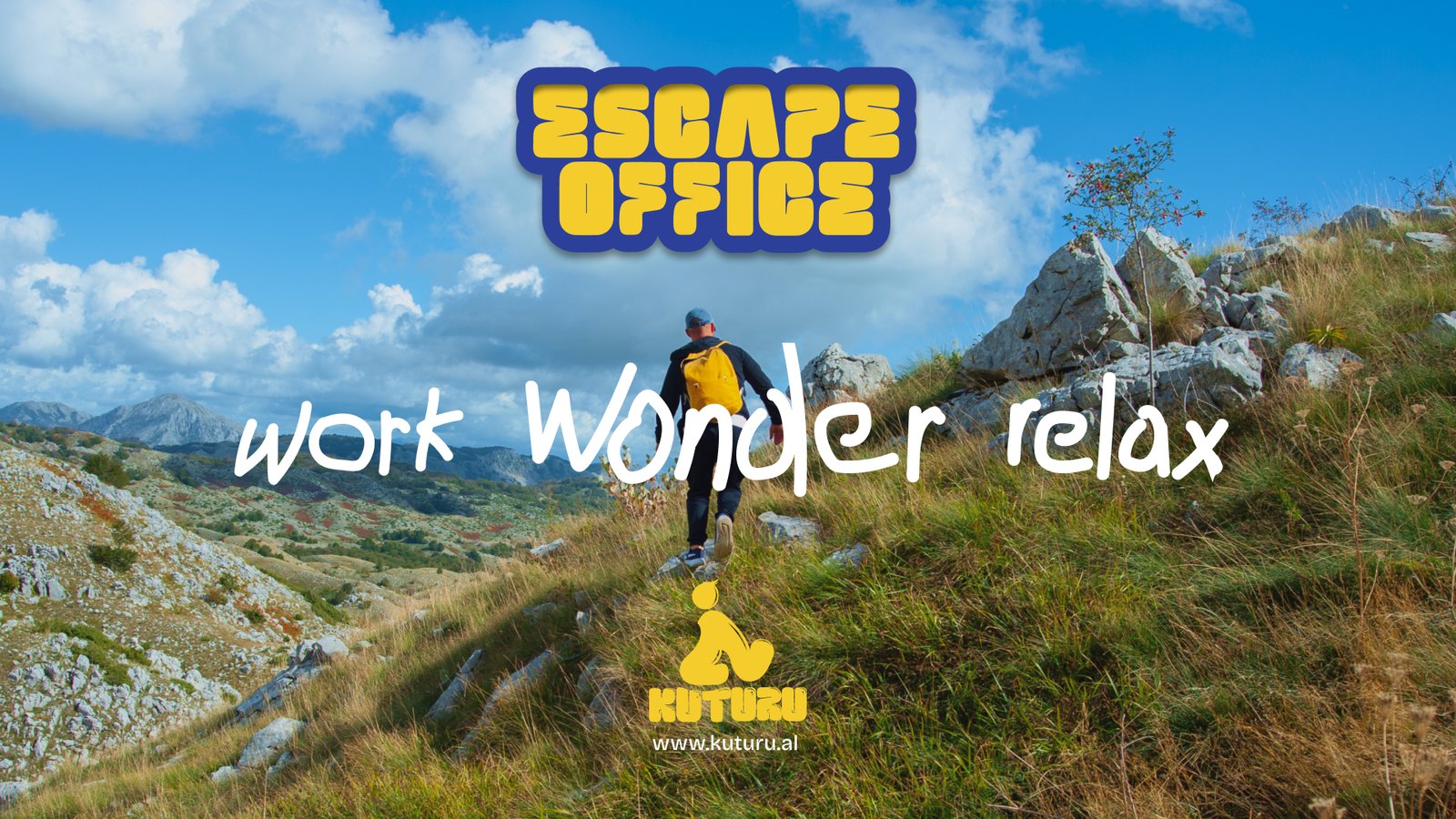
Remote work has reshaped the way people travel. For a growing number of professionals, travel is no longer just about vacations—it has become a lifestyle that blends work with the exploration of new places. Yet while the number of digital nomads has increased dramatically in recent years, the infrastructure that supports them often remains unchanged: apartments designed for tourists, not for people who need to work every day.
It is precisely within this gap that Kuturu, an Albanian startup, was born—seeking to build a different model for accommodating professionals who work remotely.
In an interview with Business Magazine, Alban Alibali, co-founder and CEO of Kuturu, explains that the idea emerged from a very practical observation during his experience in the technology sector.
“During my work with SaaS companies and digital platforms, I noticed that most accommodation platforms are built for transient tourists. Meanwhile, professionals who work remotely have completely different needs. They work up to 40 hours a week and cannot compromise on internet reliability, workspace, or quiet environments,” he says.
Kuturu was created by three co-founders with complementary backgrounds. Alongside Alibali are Aldo Cano, CTO with over a decade of experience in developing digital systems and software infrastructure, and Erlind Selba, Chief Creative Officer with a background in multimedia and brand development.
According to Alibali, the concept did not immediately emerge as a concrete product. At first, it was simply a question: why should people who work remotely have to adapt to structures that were never designed for them?
“After more than two years of research within digital nomad communities, we realized the problem was both real and widespread. From there, we started to conceptualize Kuturu as something like an operating system for workations,” he explains.
The term workation, a blend of work and vacation, has become increasingly common in recent years. However, according to the Kuturu team, the experience offered by most platforms today remains rather superficial.
In practice, this means Kuturu is not focused solely on accommodation, but also on the infrastructure that makes remote work possible.
One of the main challenges the startup has identified relates to the reliability of infrastructure in destinations such as Albania. Power outages or unstable internet connections can become serious problems for professionals whose work depends entirely on being online.
For this reason, the team has designed what it calls the Kuturu Standard—a technological package intended to ensure stability in the selected properties.
“We will pre-install mesh routers, backup internet systems and UPS power solutions. The goal is for clients to experience reliability levels that reach up to 99.9% uptime,” says Alibali.
If connectivity drops below a certain threshold, the platform also plans alternative solutions, such as immediate relocation to partner coworking spaces.
Another concept Kuturu is developing is the Arrival Survival Kits. Instead of traveling with heavy work equipment, professionals could have essential tools delivered directly to the apartment where they are staying.
“Many people travel with monitors or other work equipment. We are testing a model where clients can rent 4K monitors or ergonomic chairs that are delivered directly to their apartment,” he explains.
In its first phase, Kuturu is building an MVP that combines physical services with technology. The initial system is being developed using a no-code architecture, relying on platforms such as Base44, Lovable, NoCoDB and n8n to automate logistical processes.
Customer communication is expected to take place primarily through WhatsApp, making interactions simpler and more direct.
Beyond technology and logistics, however, one of the most interesting challenges the startup faces is perception—particularly how international visitors view Albania.
“Clients from Western Europe or the United States often have an initial doubt about infrastructure standards in the region. For this reason, we will conduct physical audits of properties and publish video reports that transparently show what is actually being offered,” says Alibali.
According to him, Albania has an important advantage when it comes to long-term stays outside the peak tourist season. Unlike traditional tourists, digital nomads often remain in a destination for months, which can create a different kind of local economic dynamic.
Although still in its early stages, the startup has already begun attracting attention through several regional initiatives. Kuturu has been selected to participate in programs such as Growpreneur 2026, PODIM 2026, and the EU-Startups Summit 2026—programs that often serve as a springboard for startups seeking pre-seed funding.
“Growpreneur is helping us significantly with planning the MVP phase and testing the service with our first users. It is an important moment for us because we will learn a lot about how the product should evolve,” Alibali says.
During its first two years, Kuturu will focus on consolidating its presence in the Albanian market, starting with destinations such as Tirana, Saranda, Vlora and Shkodra. At a later stage, the startup aims to expand across the Western Balkans and along the Adriatic coast.
But according to Alibali, the ambition is not simply to create another booking platform.
“We don’t want to be remembered as just another accommodation portal. Our idea is for Kuturu to become a compass for digital nomads,” he says.
And in the end, the vision is summed up in a simple philosophy that the startup has adopted as its motto:
“Always prepared, never alone.”
0 comments