
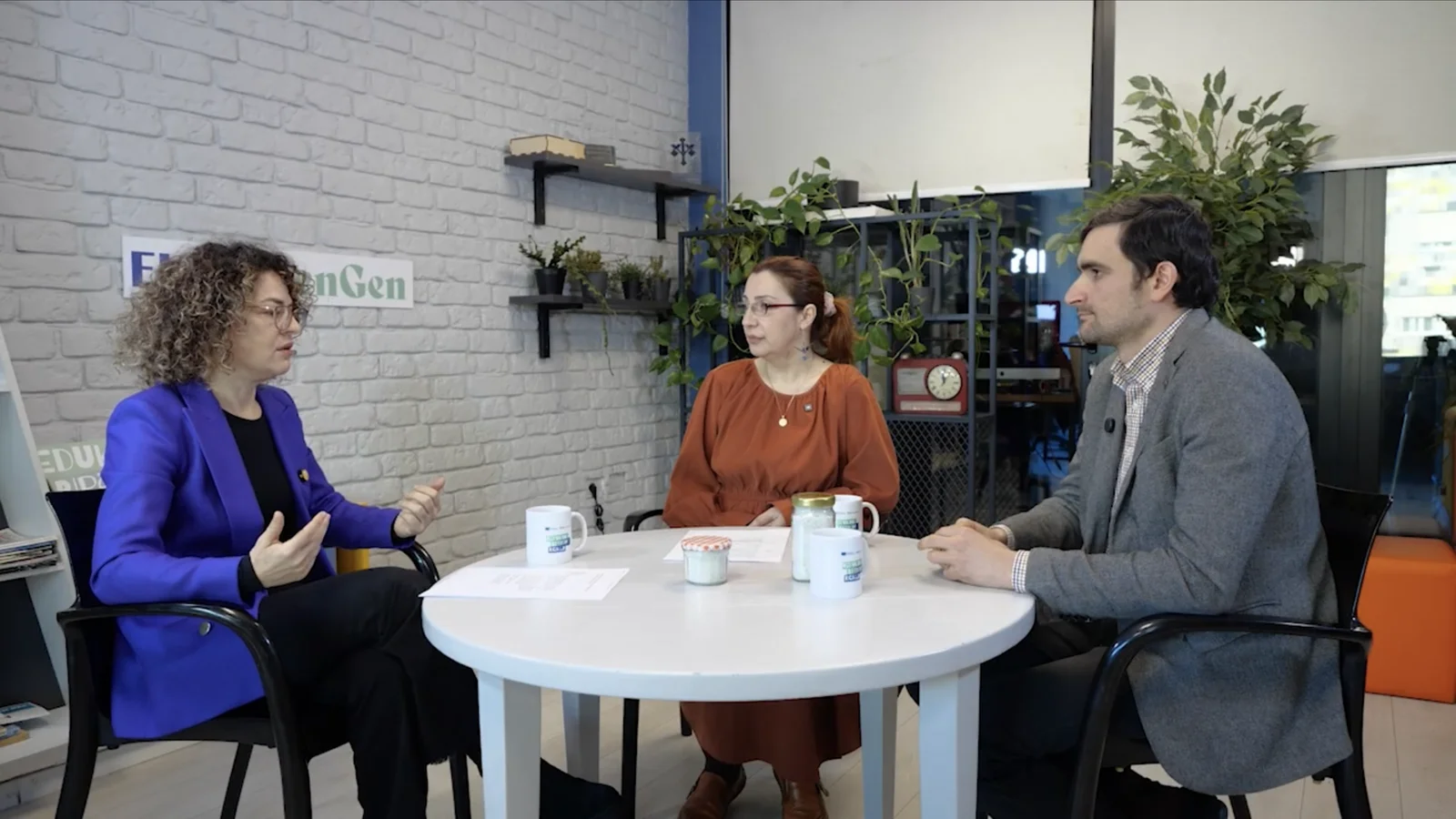
For many years, waste management in Albania has been seen as an administrative obligation—something that has to be done, not necessarily an opportunity for development. The third episode of the green economy podcast challenges this perception with a clear thesis: recycling is not just an environmental issue; it is an economic one.
The Berat Model: From Household to Public Auction
The episode focused on the case of Berat, where the municipality has implemented a waste management system over the past three years that starts at the source—with citizens—and ends with processing and commercialization.
Ervin Ceca, Mayor of Berat, explained the model through a simple yet effective logic: separation begins at home. Across the city, dedicated bins have been placed for plastic, paper, cardboard, and glass. Waste is collected by the public cleaning company and transported to a collection point near the landfill.
There, a final sorting process takes place. Recyclable materials are prepared for the market and sold through public auctions to interested businesses, while the remaining waste is disposed of in the landfill.
This system has been developed in collaboration with SIDA (the Swedish International Development Cooperation Agency), with financial support from the Swedish government—bringing international expertise and know-how to the local level.
The result? Waste is no longer just a cost. It has become a source of revenue and employment opportunities.
If it works in Berat, the natural question arises: can this model be scaled nationwide?
The Circular Economy Park: Theory Built with Reused Materials
From the institutional model, the episode shifted to private initiative. Lulzim Baumann from Circular Economy Park Albania presented another approach: the creation of a Circular Economy Park near Tirana International Airport.
The idea was not to invent something entirely new, but to integrate existing European practices into a tangible model that can be seen, experienced, and replicated.
The park’s primary focus is education—but not through theoretical presentations. It is practical education. Ecological walls built from recycled materials. Floors made of reused wood. Plastering with local clay. A space that demonstrates how sustainable construction is not an abstract concept, but a real and applicable solution.
The park is not a business that uses the circular economy as a marketing concept; it is built for the circular economy itself.
Green Skills: The Key to Transformation
The third dimension of the episode focused on the labor market. Erka Caro from Swisscontact, within the Skills4Jobs program, emphasized that skills are the key element of this transformation.
According to her, this is not about entirely new skills, but about reskilling and transforming existing ones. Investments in renewable energy—solar, wind, hydropower—as well as in recycling, require a prepared workforce.
And the market is responding. Both local and international investments are translating into job demand and new professional profiles. The green economy is creating new markets—and markets demand skills.
From Obligation to Development
The message of the third episode was clear and optimistic: recycling is not a budgetary burden, but a development strategy.
It creates jobs. It generates income. It requires new skills. It strengthens collaboration between local government, businesses, and vocational education systems.
By the end of the discussion, it became evident that the circular economy in Albania is no longer a peripheral narrative. It is being built through concrete models—within municipalities, innovative parks, and reskilling programs.
And every bottle separated at the source, every material sold at auction, every young person trained in green skills—is a step toward a more competitive economy and a cleaner Albania.
0 comments