

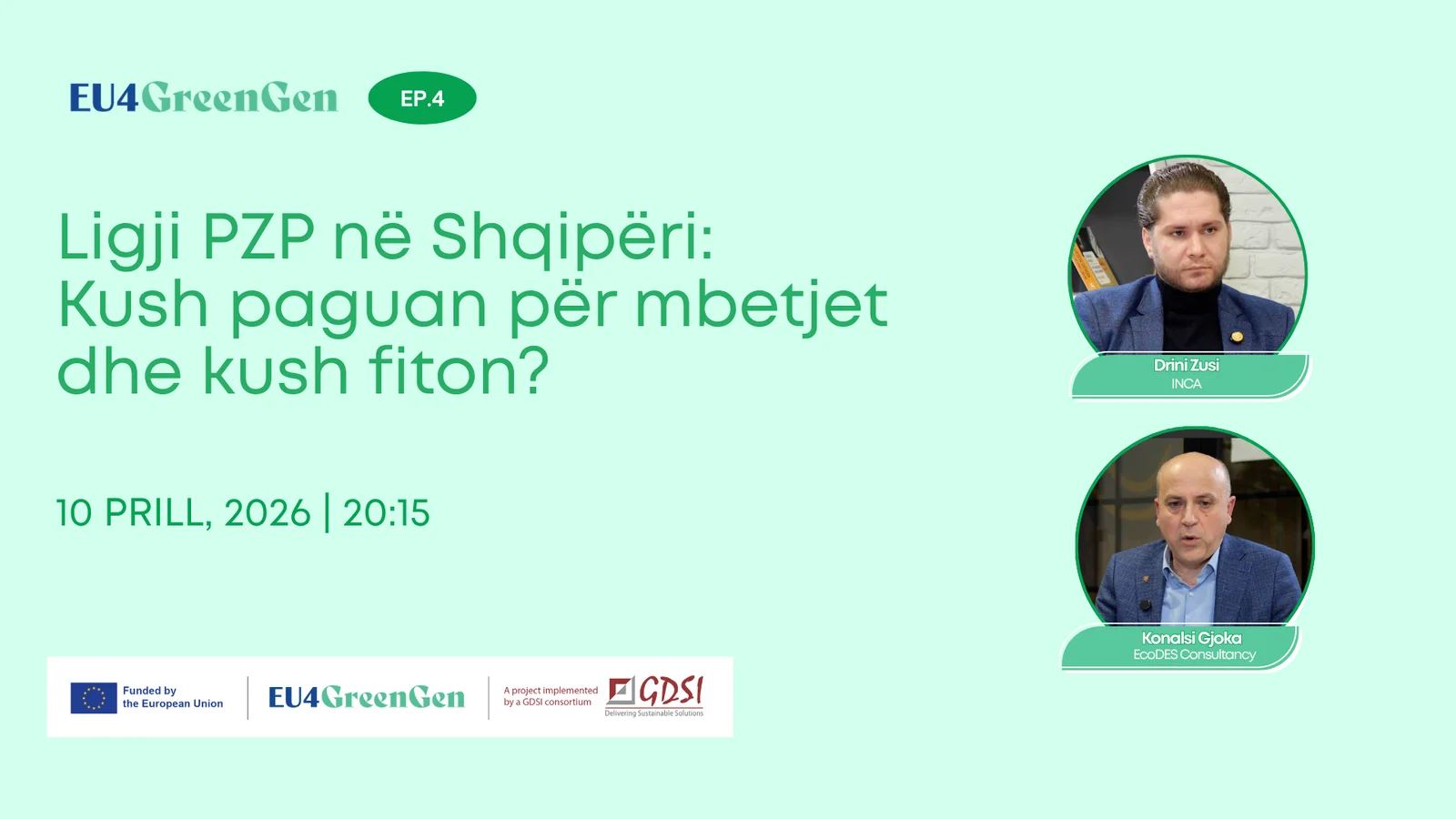
What happens when waste is no longer treated as the end of the chain, but as the beginning of a new responsibility? The fourth episode of the Green Economy podcast focuses on one of the most significant legal developments in recent years: the Extended Producer Responsibility (EPR) Law.
This is not a technical discussion for lawyers. It is a direct conversation about business, costs, innovation, and how the market will function in the years ahead.
In the studio, Konalsi Gjoka from “EcoDes” and Drini Zusi from “INCA” break down what truly changes with EPR. From the new hierarchy of waste treatment to the obligation for registration, reporting, and organizing collection and recycling schemes, the episode clearly explains how responsibility shifts to producers, importers, and distributors.
The episode tackles the key question every entrepreneur is asking today: is this law an additional burden or a new market opportunity? You will understand how packaging fees work, how they impact cost structures, and why this financial pressure can become a driver for product redesign—lighter, more recyclable, and more competitive packaging.
The episode also brings in the voice of the recycling industry, featuring entrepreneurs like Bardhyl Baltëza and Vullnet Haka, who see EPR as a tool for market stability and expansion. For them, every bottle and every jar represents not just waste, but raw material, investment, and employment.
What will you learn?
You will understand how organizations managing EPR schemes will be established, how collaboration between businesses and local authorities will be structured, and how this law may influence pricing, competition, and overall market dynamics. You will also see why transparency and accurate reporting will become an essential part of operations for every company placing products on the market.
This law does not stand alone. It aligns Albanian legislation with European Union standards and is directly linked to the obligations under Chapter 27 of EU accession negotiations. In this sense, EPR is not just an environmental reform—it is a step toward a more integrated, transparent, and competitive circular economy.
The fourth episode concludes the series, bringing the discussion from local practices and private initiatives to the legal framework that will shape the entire system. All four episodes were produced with the support of the European Union through the EU4Green Gen project, an initiative aimed at strengthening capacities and promoting sustainable practices in Albania.
If you want to understand how a single law can reshape the way we produce, sell, and consume, this is the episode to watch.
Because responsibility is no longer optional. It is a business model.
0 comments