

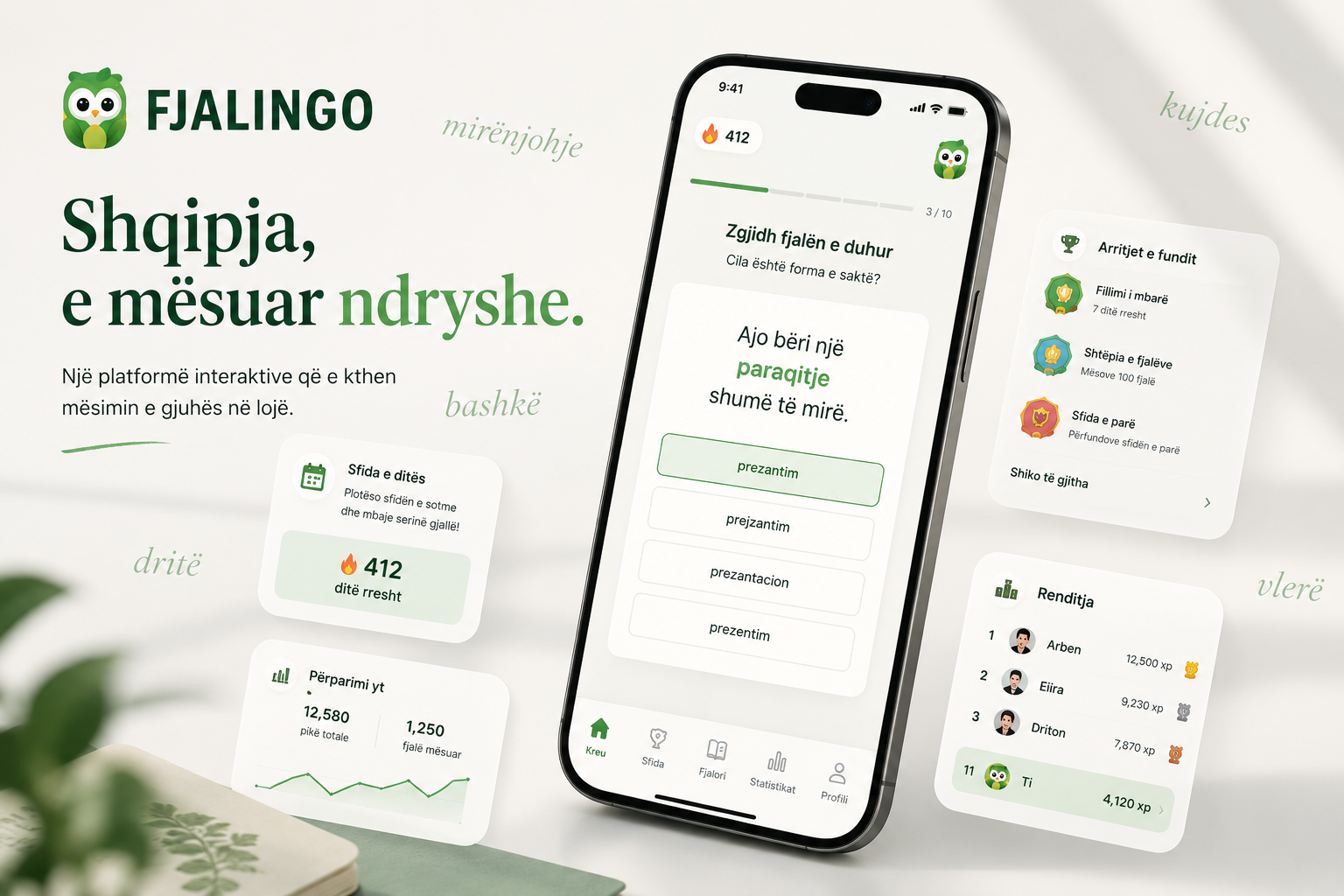
Many platforms and startups are born by following a trend. Fjalingo was born from a much more concrete problem.
While working alongside his mother—a Language and Literature teacher at the “7 Marsi” school—Arbri Hamzallari noticed that students were increasingly using foreign words, even when perfectly suitable Albanian alternatives already existed. It wasn’t a grammar issue. It was a shift in the way people communicate.
The solution did not come in the form of a textbook or a new teaching method, but as a digital platform. That is how Fjalingo was born.
Initially, it was developed as a tool exclusively for students in grades 1–9 at the school. His mother built the linguistic foundation, while Arbri developed the technology. Once the application was introduced in classrooms and began producing positive results, it became clear that the problem extended far beyond a single school.
“We’re not losing the Albanian language overnight. We lose it one word at a time,” says Hamzallari.
That realization marked a turning point. What began as an educational tool evolved into a platform designed to serve Albanian speakers wherever they live.
More Than a Duolingo Alternative
At first glance, comparisons with Duolingo seem inevitable. In reality, Hamzallari says Fjalingo addresses an entirely different challenge.
Traditional language-learning platforms are built to teach users a new language. Fjalingo is designed for people who already speak Albanian but gradually replace native words with foreign expressions—often without even realizing it.
This is a segment that existing products have largely overlooked.
For this reason, the platform focuses less on grammar rules and more on creating an engaging experience that encourages users to rediscover Albanian vocabulary through games, challenges, and interactive learning.
The philosophy is simple: people remember a word much better when they discover it themselves than when someone simply explains it to them.
Building a Platform… With the Help of AI
One of the most fascinating aspects of Fjalingo is how it has been built.
Hamzallari works almost entirely on his own. To accelerate development, he relies on artificial intelligence tools such as ChatGPT, Claude, and Cursor, while every piece of Albanian-language content is manually reviewed and verified.
In practice, AI has become a “virtual team,” enabling him to build and improve the product at a pace that would have been difficult to achieve only a few years ago.
His background in Computer Engineering at Epoka University, combined with his active presence on GitHub, has helped him approach the project as a continuous process of iteration and optimization.
Yet the challenges have not been purely technical.
One of the most difficult questions has been deciding where to draw the line between foreign words that should be replaced and those that have already become deeply integrated into everyday Albanian usage.
Equally important has been the way users interact with the platform. The goal is not to correct or criticize people, but to create an environment where enriching one’s vocabulary feels natural, engaging, and rewarding.
From an App to a Platform
The current version of Fjalingo is only the beginning.
Over the medium term, the platform aims to expand beyond replacing foreign words by introducing grammar lessons, idiomatic expressions, regional dialects, and AI-powered personalized learning tools.
At the same time, Hamzallari hopes to open the project to collaboration with linguists, software developers, teachers, and Albanian communities around the world.
His vision can be summarized in one simple idea:
Fjalingo should not remain just another app—it should evolve into a collaborative platform where the community itself contributes to preserving and enriching the Albanian language.
A Lesson from a Small Startup
The startup ecosystem often revolves around fundraising, investors, and rapid growth.
Fjalingo tells a different story.
It started with a problem identified in a classroom, was built by a single developer, and continues to grow by using artificial intelligence as a productivity multiplier.
Perhaps that is why Hamzallari’s advice to aspiring entrepreneurs is more practical than inspirational:
Don’t wait for the perfect moment. If you see a real problem and you have the ability to solve it, start building. Let the product speak for itself.

0 comments