

Article by Gerti Boshnjaku
I wanted to explore this topic further following the strong reactions to my LinkedIn newsletter, Tungjatjeta 9.0. The main trigger came from a comment by Besnik Ligaçi, when I raised the question about the communication race among banks in the country to promote Apple Pay. In his comment, he highlighted that beyond the communication campaigns, the system still seems to have some very practical gaps that need to be addressed.
Because in reality, while we discuss the latest innovations in payments, we still lack complete solutions for certain online payment models that have become standard in the global digital economy. Subscription payments, recurring payments, or other flexible mechanisms widely used by many businesses often still require foreign solutions to function properly. Albanian entrepreneurs are forced to rely on foreign platforms to operate.
This creates an interesting paradox. While we have a system that still has some practical gaps to fill, if you look closer—especially from an innovation and technology perspective, which I’ve been engaged in over the past ten years—the financial sector in Albania and the region has evolved far more than we tend to realize.
We have traditional banks trying to modernize systems built for stability, not speed. At the same time, we have fintechs and startups built “digital-first,” designed to be faster and more flexible; and recently, entirely new entrants have appeared in our market, like Jet Bank the first 100% digital bank!
This raises another interesting question: why do we continue to think, “there are no solutions here”?
Part of the answer is very practical. Many of these products exist, but they have not yet become the “first choice” for most users. They haven’t been sufficiently tested in the market, which is why people end up on global platforms that have already earned their trust. So it seems that the main challenge remains consumer education.
But at its core, what’s happening is much bigger than a marketing or communication issue.
We are in a transitional phase (I know you’ve heard this often over the past 35 years, but it’s true in this case 😊).
On one side are the traditional bank institutions—trying to transform their decades-old infrastructures and operating protocols to align with new technologies and innovations.
On the other hand, running in parallel, is a growing group of actors: fintech companies and tech startups built from day one on modern digital architecture. These companies operate differently. They are more agile, experiment faster, and follow models proven in other markets.
At the center of this dynamic is the consumer. They are the ultimate target of this race—but they are also part of the transition. Beyond the confusion created by the sheer number of solutions and service variety, the consumer must also undergo a cultural shift: from a traditional user to a digital user.
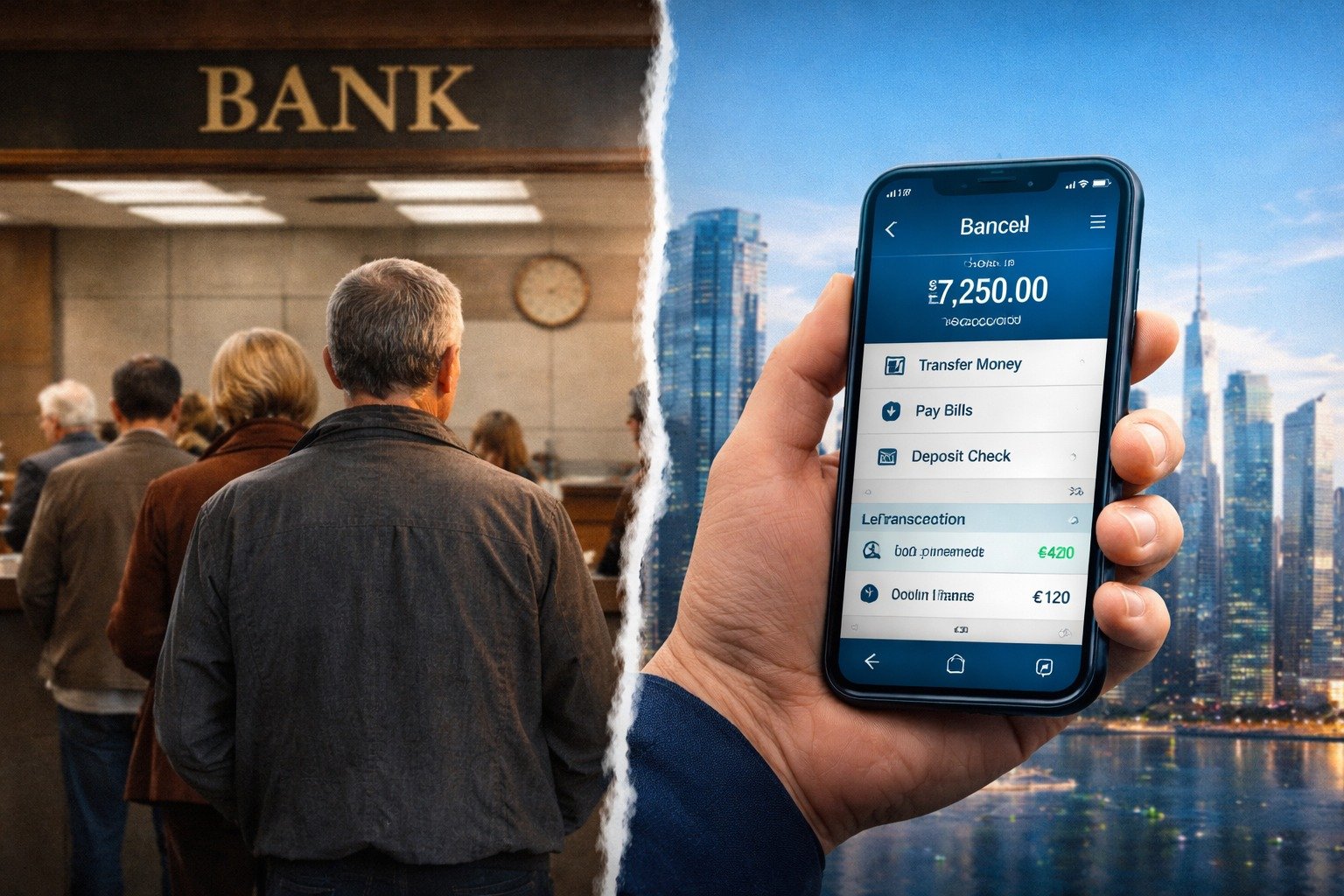
From someone who physically visits the bank for every service, to someone who expects everything to be instantly available on their phone.
Practically speaking, this situation favors the consumer. The more competition among service providers, the better the experience: less bureaucracy, more speed, and greater simplicity.
If we try to project a bit into the future, the direction seems relatively clear. The coming generations have far higher digital competencies, and this is already reflected in how banks communicate.
In my last newsletter, I mentioned how bank marketing campaigns, once very traditional and cautious, now use influencers and social media language to speak to younger generations. This isn’t just marketing—it’s a signal of the transformation of the banking model.
Chances are, in the near future, banking will be almost entirely digital.
But what does this mean in practice?
A fully digital bank provides services through online channels, without physical branches, enabling access to accounts, payments, and other products via apps and web platforms. In Europe, this model is growing rapidly. According to a quick search and a European Central Bank report, by the end of 2024, over 20 banks in the eurozone identified as digital-only, gradually gaining share of total banking system assets.
The advantages are clear: 24/7 access, account opening in minutes, lower fees, and much simpler user experience. Security is no longer a significant obstacle. Digital banks use modern encryption protocols, multi-factor authentication, and are subject to the same regulatory requirements for deposit protection as traditional banks. Native digital infrastructure also offers flexibility, faster updates, and easier integration with new technologies.
In this context, emerging technologies like Artificial Intelligence (AI) and the rapid development of LLMs are further accelerating the transformation. AI chatbots are already part of our daily lives, and often we interact with them without knowing if there’s a human on the other end. Soon, it won’t even matter. If communication is clear and issues are resolved instantly, the experience remains positive.
AI can even deliver something the traditional system struggled with: personalization at scale. By analyzing usage data and history, systems can and will offer tailored solutions for every user.
Of course, this doesn’t happen overnight. But with generational change and the growing volume of data generated by digital interactions, it’s an almost inevitable development.
Competition among providers will increasingly focus on the client experience: fast digital onboarding, personalized customer journeys, secure 24/7 access, and intelligent transaction monitoring.
Inevitably, the day will come when the bank serving us is no longer a physical building we visit—but a digital ecosystem that accompanies us daily.
No queues. No counters. Just a touch on the screen.
This article is part of the “Tungjatjeta” series, a personal newsletter by Gerti Boshnjaku on LinkedIn focused on business, innovation, and digital transformation.
📩 You can subscribe to follow it and receive each new edition directly in your inbox.
0 comments