

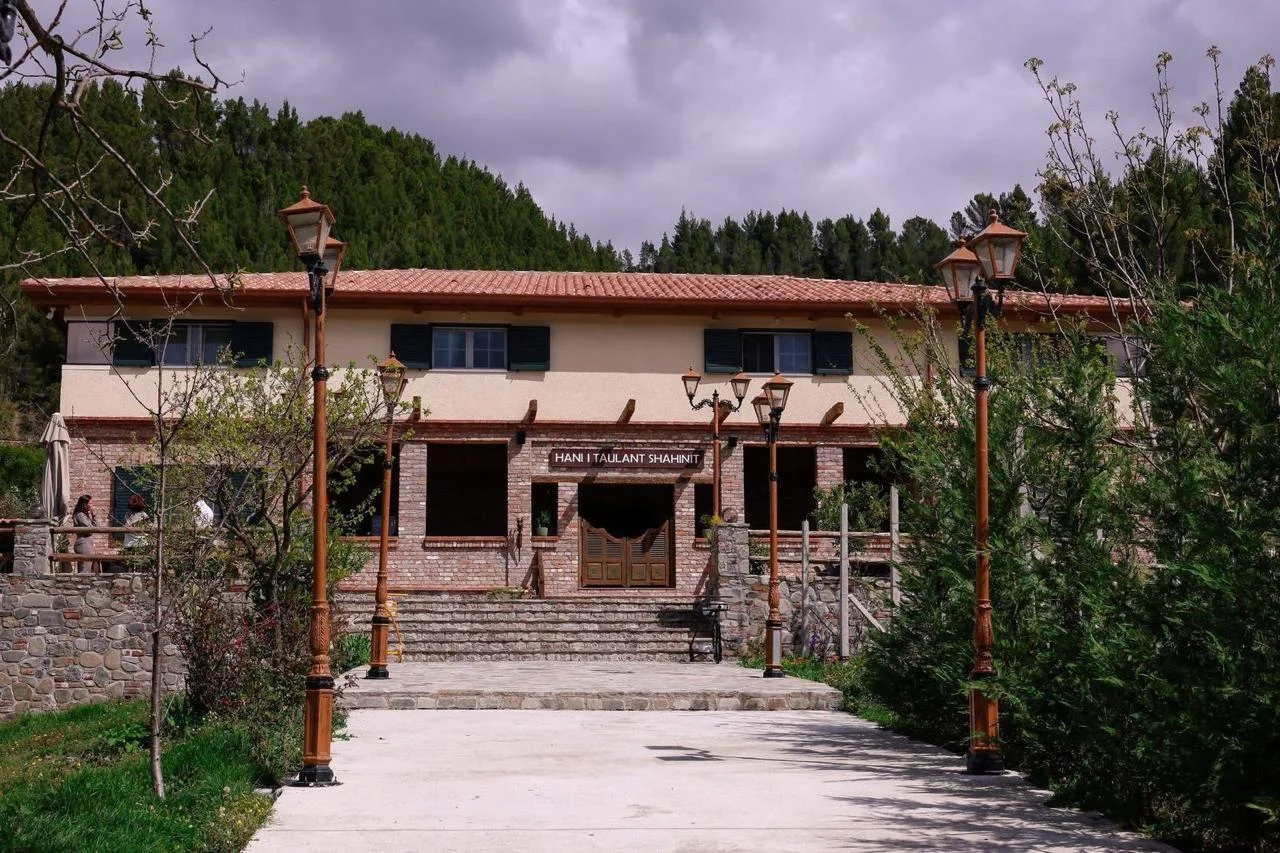
In Kodovjat, far from the noise of cities and the fast pace of everyday life, there is a place where time seems to move differently. An inn that is not just a restaurant or a guesthouse, but a family story brought back to life. “Hani i Taulant Shahinit” was not born as a business idea on paper, but as the continuation of a tradition whose roots go back more than a century.
At the end of the 19th century, Taulant’s great-grandfather, together with his brothers, opened the first inn on this land. Today, that story has been revived and adapted to the needs of modern tourism.
“I wanted to create a destination where guests don’t come only to eat or sleep, but to experience village life as it once was,” says Taulant. His many years of experience in hospitality helped him build a model where tradition and modern standards coexist, without compromise.
Building rural tourism in Albania is not an easy path. Compared to Tirana or larger cities, the challenges are greater, the rhythm is slower, and every step requires more energy.
“These challenges are the reason I wake up earlier and go to sleep later,” he says. Yet, the distance from urban life and the calm of nature are exactly what make the experience more authentic and sustainable in the long run. Visitors who choose the Inn are not just looking for service, but for the feeling of disconnecting from everything artificial.
Read also: Bujtina “Pazari i Vjetër”, returning to the roots of Hasian taste and hospitality!
The philosophy of the Inn is simple: source as much as possible from the local area. A large part of the food comes directly from the family’s own farm, while the rest is supplied through collaboration with the residents of Kodovjat for milk, meat, vegetables, and seasonal products. This cooperation is not only economic, but also social. Money circulates within the community, farmers are encouraged to grow a wider variety of produce and raise livestock, because they know they have a stable market. For the guest, this means real flavors. For the area, it means an economic life that does not fade away.
The Inn’s menu is not built around “Instagrammable” dishes, but around authenticity.
“The aromas in the kitchen and the flavors on the table make our recipes just as sought-after,” he says. The recipes are prepared from start to finish in the Inn’s kitchen, using ingredients that carry history and the scent of the land. The difference between industrial food and food grown from your own land is felt on the plate, but also in the guest’s memory. These are the flavors you don’t easily forget and that make you want to come back.
Over the years, the biggest challenge has been maintaining quality while growing. It is easy to increase volume, but much harder to keep the same standards. For Taulant, expansion only makes sense if it does not compromise the guest experience. That is why future plans are not focused only on physical growth, but on deepening the experience: relaxation spaces among olive trees, a pool serving the guesthouse, villas for more privacy, and outdoor activities that turn a stay into a complete experience, not just a short stop.
Among all this vision, the message to young people who want to open rural guesthouses is clear: patience, dedication, and hard work. Rural tourism does not work on a part-time basis. It is a way of life more than a classic business model. When asked what advice he would give to young people who want to follow the same path, he answers:
“Patience, dedication, and hard work. Rural tourism doesn’t work as a half-time job.”
“Hani i Taulant Shahinit” is not a tourist destination in the usual sense. It is a return to the roots, a way to show that Albanian hospitality is not just a folkloric memory, but can be a modern model of sustainable development.
At a time when many are looking for quick success, “Hani i Taulant Shahinit” proves that sustainable growth starts from the land, from people, and from respect for history.
0 comments