

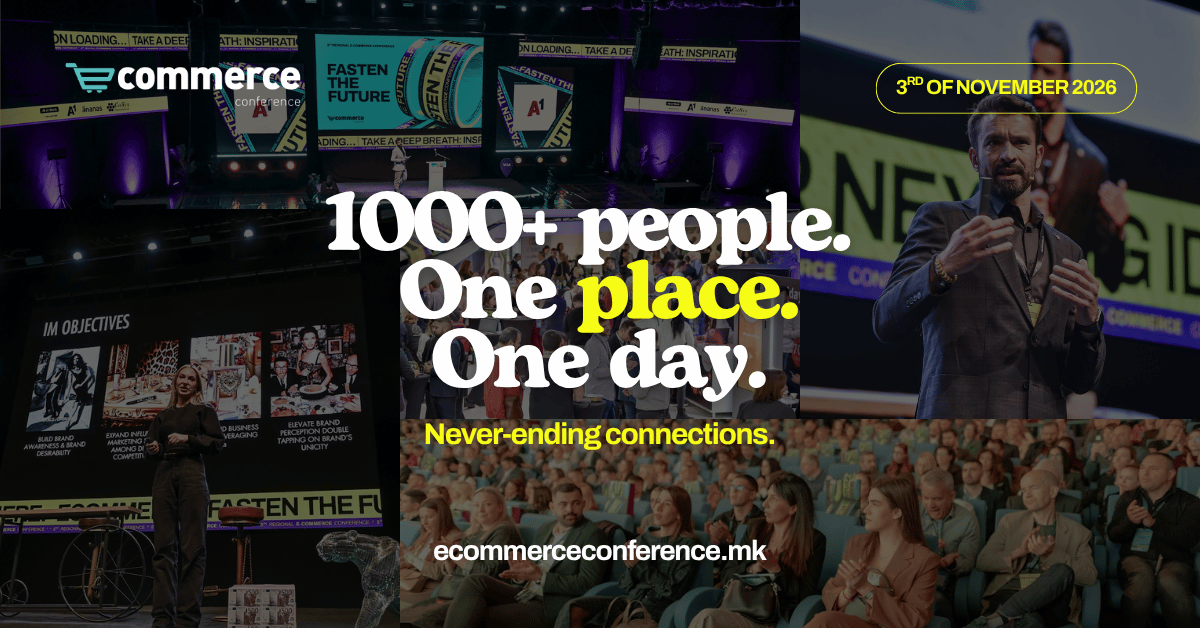
Despite progress in digital connectivity, the Western Balkans still lags behind in making the most of e-commerce opportunities. Digital skills, payment habits and businesses’ readiness for digital transformation are among the key challenges that will be in focus at the 9th Regional E-commerce Conference, taking place on 3 November in Skopje.
Western Balkan economies have made significant progress in internet access and financial services, but data shows that digital connectivity does not automatically translate into greater participation in the digital economy. The gap between internet use and online shopping, underdeveloped digital skills and the continued prevalence of cash payments point to considerable untapped potential for e-commerce growth across the region. These are among the findings of the latest annual analyses by the Macedonian E-commerce Association (MECA), which will be presented at the 9th Regional E-commerce Conference.
Digital skills remain one of the biggest challenges. According to Eurostat data included in the analysis, in 2025, 30.9% of internet users in North Macedonia had basic or above-basic digital skills. This shows that, alongside infrastructure and access to technology, further development of the digital economy also requires strengthening the capabilities of citizens and businesses.
At the same time, financial inclusion data shows that 84.3% of adults in North Macedonia have an account with a financial institution or a mobile money service provider. However, access to financial services does not necessarily mean that these services are fully utilised for digital transactions.
Payment habits are also the focus of a dedicated study on cash on delivery versus digital payments in e-commerce in North Macedonia, conducted with the support of Visa. According to the survey of e-commerce businesses, 68.2% of the online stores surveyed reported that more than half of their orders are paid for in cash on delivery.
These findings raise important questions about consumer trust, shopping habits and the barriers to wider adoption of digital payments.
“Today, the challenge is not simply how many people have access to the internet or a payment card, but how many actually make use of the opportunities available to them. The region has made significant progress in digital connectivity, but there is still considerable room for improvement in digital skills, online shopping and digital payments. This gap represents enormous potential for growth. And while we work to overcome these challenges, global e-commerce is already entering a new phase in which artificial intelligence is changing the way we buy, sell and compete. This makes it more important than ever for businesses in our region to accelerate their adaptation and prepare for the changes ahead,” said Nina Angelovska Stankov, President of the Macedonian E-commerce Association.
With the aim of connecting the real challenges facing domestic and regional markets with global trends and practical solutions, the 9th Regional E-commerce Conference will take place under the theme “From Wait to Go: E-commerce at AI Speed!”. The conference will bring together more than 1,000 participants from over 12 countries, more than 30 local and international speakers, and over 50 partners. The programme will run across two parallel stages: the Main Stage and the Practical Stage.
Speakers will include experts from global companies such as Amazon, Google DeepMind, LinkedIn, Visa and Tesla, as well as Decathlon, Wolt, Ananas Ecommerce, Gjirafa, Iute and other regional and international companies. Topics will include the application of artificial intelligence and AI agents, the future of online shopping, cross-border sales, building brands and customer loyalty through gamification, mergers and acquisitions (M&A), and the impact of global platforms and logistics services.
Special focus will be placed on the development of e-commerce in the Western Balkans, including the presentation of new regional analyses and findings from the study on payment habits in North Macedonia. Discussions with industry representatives will also explore the challenges related to growth, competitiveness and investment in the region.
Alongside the main programme, the Practical Stage will offer actionable strategies and insights from companies and experts, while the exhibition area and networking activities will provide opportunities to establish new contacts and develop business partnerships.
“Our goal is for the conference to be more than a place to follow global trends. We want it to be a platform where we can better understand the challenges in our market, learn from the best global and regional practices, and unlock concrete growth opportunities. That is why we bring together data and research with practical experience, technology and the people shaping the future of e-commerce,” added Angelovska Stankov.
The conference is organised with the support of Visa as Platinum Partner; CaSys as Strategic Partner; Iute Macedonia as Fintech Partner; A1 Macedonia as Digital Partner; Diners and Ananas as Gold Partners; Komercijalna Banka, Halkbank, Sava Pension Company, NLB Bank and Wolt as Silver Partners; and Mint, Sava Insurance, Uni Banka, Euroins, RSM, Akcija24, Pivara Skopje, Zegin, EVN, Markev and ELS as Bronze Partners, alongside numerous other partners and collaborators.
The agenda for the 9th Regional E-commerce Conference is available on the https://ecommerceconference.mk/ , where interested participants can also secure the remaining tickets.
0 comments