

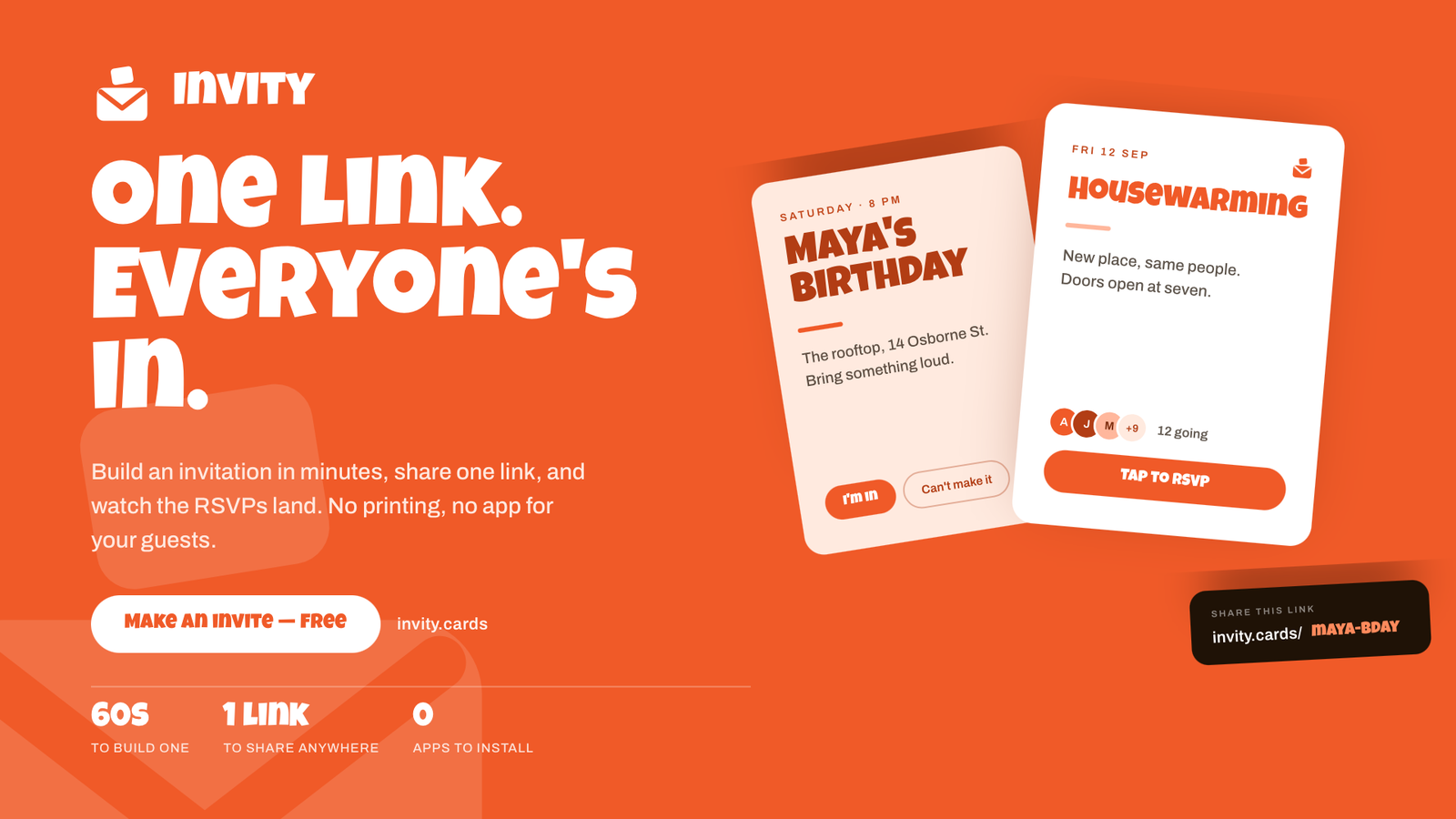
There’s a moment most of us know all too well: the event is planned, the date is set, but the guest list is still either in your head or buried in an endless WhatsApp conversation. “Are you coming?”, “What about you?”, “I’m still not sure” — endless messages, no clear answers, and the time that should be spent enjoying the event ends up being spent organizing it.
It was precisely from this small but universally familiar problem that Invity was born. A platform that transforms the digital invitation from simply being a traditional card moved online into a real digital experience: one beautiful link that opens without an app or an account and collects responses automatically.
We spoke with Dean Hasani, the founder and developer behind Invity, to understand how the idea came about, what makes the platform different, and why he believes the best product is one that “disappears into the background” and simply makes life a little easier.
Tell us a little about yourself. What is your background, and how did the idea for this platform come about?
I’m Dean Hasani, a Full-Stack software and mobile application developer with a background in Computer Science and Software Development. For several years, I’ve been creating digital products, from the initial idea and design to technical development and implementation.
During this time, I’ve worked on a variety of projects, including e-commerce platforms, SaaS products, mobile applications, CRM systems, and custom solutions for businesses in Albania and international markets. This has given me the opportunity to understand not only the technical side of development, but also the real problems users and businesses face.
The idea for this platform came directly from the desire to solve a specific problem in a simpler and more modern way. While working on different projects, I noticed that many processes are still complicated, fragmented, or require too much time to manage. That’s how the idea of building a platform that would make this process easier, more organized, and more accessible for users began.
What motivates me most is not simply building an application that works, but creating a product that has a real purpose and can provide value to the people and businesses using it. I’ve followed this same approach with my other projects, and it’s what pushed me to turn this idea from a concept into a real platform.
What makes Invity different from the other tools people use today to send digital invitations?
Invity was built around a very simple idea: a digital invitation should be as easy to create and open as it is to send a message.
Many existing platforms still treat digital invitations as online versions of traditional invitations. You create a design, enter the event details, add guests, and then send the invitation to each person individually. In some cases, the person receiving the invitation even has to register or create an account to confirm their attendance. This creates unnecessary friction between receiving the invitation and responding to it.
Invity simplifies the entire process into a single link. The organizer creates the invitation, gets the link, and shares it wherever they already communicate with their guests: WhatsApp, Instagram, Messenger, SMS, or any other platform. The guest simply opens the link, sees the invitation, and confirms whether they will attend — without downloading an app or creating an account. For the organizer, responses are collected automatically, and they receive a notification whenever a guest accepts or declines the invitation.
Another element that sets Invity apart is its focus on experience and personalization. An invitation isn’t simply a static image or a template with a few customizable colors. The platform offers different designs and effects that make invitations more interactive and better suited to the character of each event. A birthday, a wedding, a business event, or a Halloween party should each have a completely different visual identity.
At the same time, we wanted pricing to remain simple and transparent. The free version is sufficient for everyday use, while the Pro version offers additional features for users who create invitations more frequently. There are no per-guest fees, complicated credit systems, or hidden costs.
Ultimately, what makes Invity different isn’t just the design. It’s the way we’ve approached the entire experience: fewer steps for the creator, zero barriers for the guest, and an invitation that feels like a true digital experience rather than simply a traditional card moved online.
What does the ideal experience look like for someone creating and sending an invitation with Invity?
For me, the ideal Invity experience should be so simple that you barely feel like you’re using a platform at all.
Imagine a very ordinary situation: it’s 11 p.m., and you suddenly remember that you’re having a party on Saturday and haven’t invited anyone yet. You open Invity on your phone, enter the event name, date, time, and location, choose a design you like, and get a link. You copy it, send it to your WhatsApp group, and that’s it. Ideally, the whole process should take less than a minute.
That’s exactly the experience I want to create with Invity: you shouldn’t have to think about the platform at all, only about the event you’re organizing.
People don’t wake up in the morning thinking, “I need software to create invitations.” They simply want to organize a birthday, a dinner, a wedding, or an event with their friends. So, if someone has to stop and ask themselves, “How does this work?”, then I think we’ve added something unnecessary.
I want the experience to be just as simple for the person receiving the invitation. I don’t want an invited friend to have to download an app, create an account, or fill out a form just to say, “Yes, I’m coming.” They simply open the link, view the invitation, choose whether they’ll attend, and continue with their day.
Ultimately, I believe a good product is one that disappears into the background and simply makes life a little easier. That’s the experience I want Invity to provide: fewer steps, fewer obstacles, and more focus on the moment people are organizing together.
What have been some of the most interesting or surprising reactions you’ve received from users so far?
One of the things that has impressed me most hasn’t been a comment about Invity’s design or one of its technical features, but rather the way people have started using it in completely ordinary situations in their everyday lives.
I remember one piece of feedback that made me realize Invity was solving a real problem. One user was organizing a birthday party and told me that, before using Invity, she had spent a lot of time messaging people individually: “Are you coming?”, “What about you?”, “Do you know yet?”
In the end, she had a collection of responses scattered across WhatsApp, some missed messages, and she still wasn’t completely sure how many people were actually coming.
With Invity, she simply sent one link and started watching the responses come in automatically. On the surface, it seems like such a small thing — just a “Yes” or “No” button — but for her, at that moment, it meant much less stress and much more time to focus on the event itself.
I’ve particularly appreciated these reactions because they’ve reminded me of something important: the value of a product isn’t always measured by how many features it has, but by how effectively it removes a small problem from someone’s everyday life.
And perhaps that has been the most pleasant surprise for me. I built Invity thinking a lot about technology, design, and how the platform works, while users have shown me that what they value most is something much more human: not wasting time organizing the people they care about.
When something you’ve built actually starts making someone’s life a little easier, that’s when you realize you haven’t simply built a website. You’ve built something that has a reason to exist. And for me, that’s the most rewarding feedback you can receive.
What has been the most difficult or challenging part of building the platform?
One of the biggest challenges in building Invity has been finding the right balance between simplicity and functionality.
From the beginning, I knew very clearly that I didn’t want to build a platform that felt complicated. I wanted someone, whether they were 18 or 60 years old, to open Invity and immediately understand what they needed to do.
But at the same time, a lot had to happen behind that simplicity: creating and customizing invitations, animations, real-time RSVPs, notifications, data storage, and providing a good experience across a wide range of mobile devices.
At certain points, every new feature I added made the product slightly richer, but also slightly more complicated. That’s when I had to stop and ask myself: “Am I doing this because the user genuinely needs it, or simply because I can technically build it?”
That has been one of the most important lessons for me throughout this project. As a developer, it’s very easy to be tempted to add new features. But as a product creator, you also need to know what not to build.
One concrete example was optimizing the visual invitations. I wanted them to have animations and feel modern, but I didn’t want a beautiful invitation to take several seconds to load. So I spent a lot of time testing different ways to keep the animations lightweight and optimize performance, particularly on mobile devices.
In the end, the challenge wasn’t purely technical. It was knowing where to stop. For me, Invity is a great example of how building something that feels simple to the user can require a great deal of complexity behind the scenes.
How do you see the role of digital invitations in the future of event planning?
I believe the shift from traditional invitations to digital ones has already happened. People no longer need to choose between paper and email; today, a large part of our communication takes place directly on our phones and through the social apps we use every day.
What I think will change most is the very concept of an invitation.
A digital invitation doesn’t have to be simply an online version of a paper card. It can be a living, interactive experience. It can be updated if the event time or location changes, instantly show who has confirmed their attendance, and give the organizer a much clearer overview of the event without having to maintain Excel lists or send dozens of individual messages.
I also think the way we invite people should adapt to the way we communicate today. Events are often organized in WhatsApp groups, on Instagram or Messenger, or simply through a link sent to a friend.
For me, the ideal invitation is one that can be created and shared in seconds without interrupting the conversation that is already happening.
And here too, I believe technology should be smart, but not complicated. An invitation is connected to a specific moment. Once the event is over, the invitation has fulfilled its purpose.
That’s why I think that, in the future, invitations will increasingly become temporary, dynamic experiences rather than static documents that remain online forever.
Where do you see Invity going in the future? What do you want to achieve with the platform?
For Invity’s future, I want to focus on one very specific goal: making the process of organizing an event even easier without making the platform more complicated.
In the shorter term, I want to further improve guest management, RSVPs, and reminders. One particularly useful feature would be giving organizers a simple way to remind people who haven’t responded yet, without having to message each person individually.
But I also have a very clear idea of what I don’t want Invity to become.
I don’t want Invity to turn into a huge event-management software platform with ticketing, seating charts, budgets, detailed event management, and dozens of menus you have to learn before you can use it. There are already very good platforms that do exactly that.
I want Invity to preserve its identity: an exceptionally fast, beautiful, and simple way to create an invitation and bring it directly into the conversation with the people you want to have around you.
The free model is also part of this philosophy. I want someone organizing a birthday, a dinner with friends, or a small celebration to be able to use Invity without feeling as though they’re entering a free trial that will ask them to pay tomorrow. The free version should be genuinely useful, while Pro should provide real additional value for those with greater needs.
Ultimately, my goal is very simple: when someone thinks, “I need to invite people to this event,” I want Invity to be one of the first things that comes to mind.
If we can reach the point where someone can create an invitation in just a few seconds and say, “That was much easier than I expected,” then I believe Invity has achieved its purpose.
0 comments