

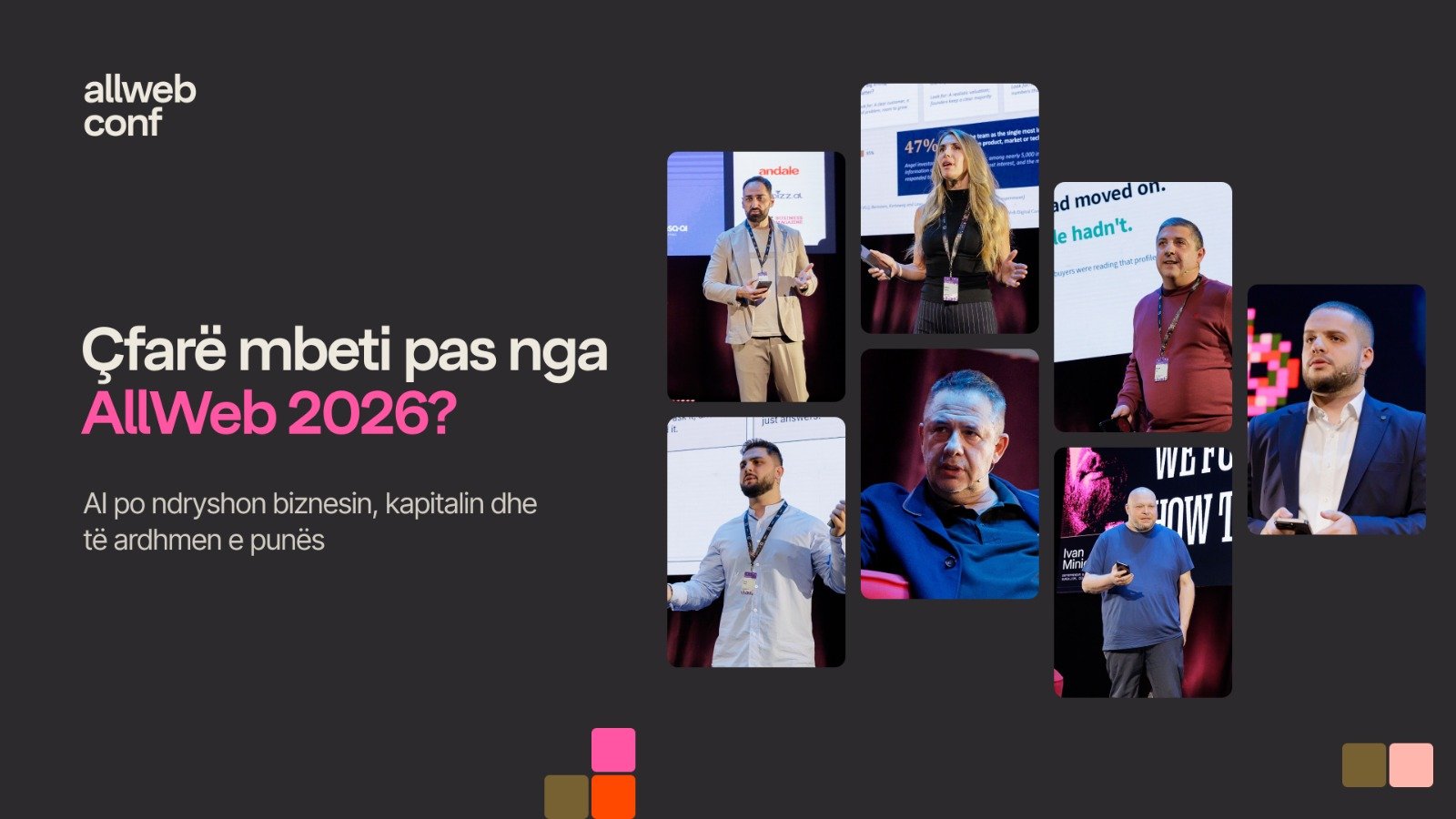
Samir Mane predicts that the four-day workweek could become a reality by 2030, while experts with experience at Google, Apple, Adobe, and SAP explore AI’s impact on business growth, startup funding, and the future of work. At AllWeb Digital Conf 2026, the conversation around Artificial Intelligence shifted from technological potential to its real-world impact on business and the economy.
Artificial Intelligence is no longer simply a technology that helps companies automate processes or save time. It is transforming how businesses are built, how investment decisions are made, how teams are organized, and how value is created in the market. For companies, the question is no longer whether to adopt AI, but how quickly they can integrate it into their strategies and operations.
This transformation was at the heart of AllWeb Digital Conf 2026, held on November 6 at Arka Art Hotel in Tirana under the theme “ALL FOR AI & AI FOR ALL.” The conference brought together more than 300 participants representing 100 different companies, including business leaders, entrepreneurs, and international experts, to explore how Artificial Intelligence is reshaping economic models and the future of work.
One of the most compelling perspectives came from Samir Mane, Founder and President of BALFIN Group, who predicted that the four-day workweek could become a reality within the next four to five years, potentially by 2030.
“I believe that in the next four to five years, perhaps even by 2030, everyone will be working four days a week. And this is not just an idea. Within BALFIN Group companies, we have already started working toward making this happen,” Mane stated.
His prediction takes the AI conversation beyond immediate productivity gains. If technology enables the same amount of work to be completed in less time, the implications extend to working hours, employer-employee relationships, and how the benefits of increased productivity are distributed.
Mane also emphasized that Artificial Intelligence should be treated as a public good, accessible to everyone and serving humanity as a whole. While technological transformation will replace certain professions, he believes it will also create new employment opportunities.
From Business Growth to New Business Models
An international perspective on technology’s potential to accelerate business growth came from Todd Rowe, a former executive at Google, Apple, Adobe, and SAP.
During his career at Google, Rowe led the growth of a business unit from $250 million to $8 billion. At AllWeb, he shared insights from his experience in scaling businesses and teams, exploring how Artificial Intelligence can help companies adapt their operating models and strengthen their competitiveness.
For businesses, the challenge is not simply purchasing or adopting new technological tools. It is understanding where those tools can create real value, whether through productivity improvements, more efficient processes, better customer service, or the development of new products and services.
This topic was also explored by Damjan Dano, Founder of Aqtos, who presented a perspective on collaboration between people and AI Agents. AI Agents represent a new stage in the evolution of Artificial Intelligence, enabling systems to go beyond generating responses and actively support the execution of tasks and business processes.
Meanwhile, Klaus Coka, Head of AI Platforms at Raiffeisen Bank Albania, addressed the transition from AI experimentation to practical business solutions.
The financial sector’s perspective is particularly relevant, as banks and financial institutions face demanding requirements for efficiency, security, and service quality. For these organizations, AI integration must deliver measurable results and form part of a broader organizational transformation.
Investors Are Looking for More Than Good Ideas
Artificial Intelligence is also changing how entrepreneurs identify investment opportunities and build relationships with capital providers.
In her presentation, “Investor Ready in the Age of AI,” Eljona Shkreli, Founder of H E R Advisory, who brings experience from J.P. Morgan Private Bank and Citi Private Bank, explored the impact of technology on investment processes, startup financing, and relationships between entrepreneurs and investors.
According to Shkreli, AI is accelerating the identification and analysis of investment opportunities, but trust, transparency, and human relationships remain essential to securing capital.
“Technology moves capital. Trust keeps it there,” was one of the central messages of her presentation.
For Albanian startups, Shkreli emphasized that the challenge is no longer limited to generating ideas or accessing talent. A critical issue is building the bridge between early-stage funding and private capital.
This requires strong corporate governance, professional reporting, and connections with international investors.
It is a dimension often overlooked in discussions about technology. A startup may use AI to develop products faster or analyze markets more efficiently, but this does not eliminate the need for a sustainable business model, responsible management, and transparency toward investors.
Technology Is Changing Work, but Who Benefits from Increased Productivity?
Samir Mane’s prediction about the four-day workweek, alongside discussions from other AllWeb speakers, raises a broader question: How will the productivity created by Artificial Intelligence be used?
Will it translate into greater competitiveness for companies, better working conditions for employees, or entirely new organizational models? And how will professionals adapt to a labor market in which certain tasks are automated while new roles and skill requirements emerge?
Mane pointed out that technological transformation will replace some professions while creating new employment opportunities.
This shift requires companies to rethink not only their technology investments but also the skills they expect from employees and the ways they build and manage their teams.
One of the strongest messages emerging from AllWeb Digital Conf 2026 was that AI adoption is no longer an isolated decision made by technology departments. It has become a strategic business decision affecting corporate leadership, investor relationships, workforce organization, and market competitiveness.
With more than 300 participants from 100 different companies, this year’s edition of AllWeb confirmed the business community’s growing interest in understanding AI beyond technological promises and exploring its practical applications as a driver of growth.
Since 2016, AllWeb has evolved into a platform connecting the marketing, technology, communications, and entrepreneurship communities.
In 2026, the discussion centered on a question that will help shape the coming years: not simply how much Artificial Intelligence can achieve, but how people and companies will choose to use it.
AllWeb Digital Conf 2026 was organized by New Media Digital and Business Magazine, with the aim of connecting international expertise with the business and technology communities in Albania and the wider region.
0 comments