
By Eni Muça
In the world of technology and global logistics, few Albanian success stories are as inspiring as that of Krenar Komoni, Founder and CEO of Tive, the company transforming how goods in transit are monitored across the globe.
From a teenager working in Kosovo’s first post-war media outlets to leading a company with more than 300 employees across 18 countries, his journey is proof of the power of vision, perseverance, and innovation.
According to private market estimates, Tive’s valuation is believed to be between $545 million and $565 million, placing the company among the most successful entrepreneurial stories created by Albanians on the international stage.
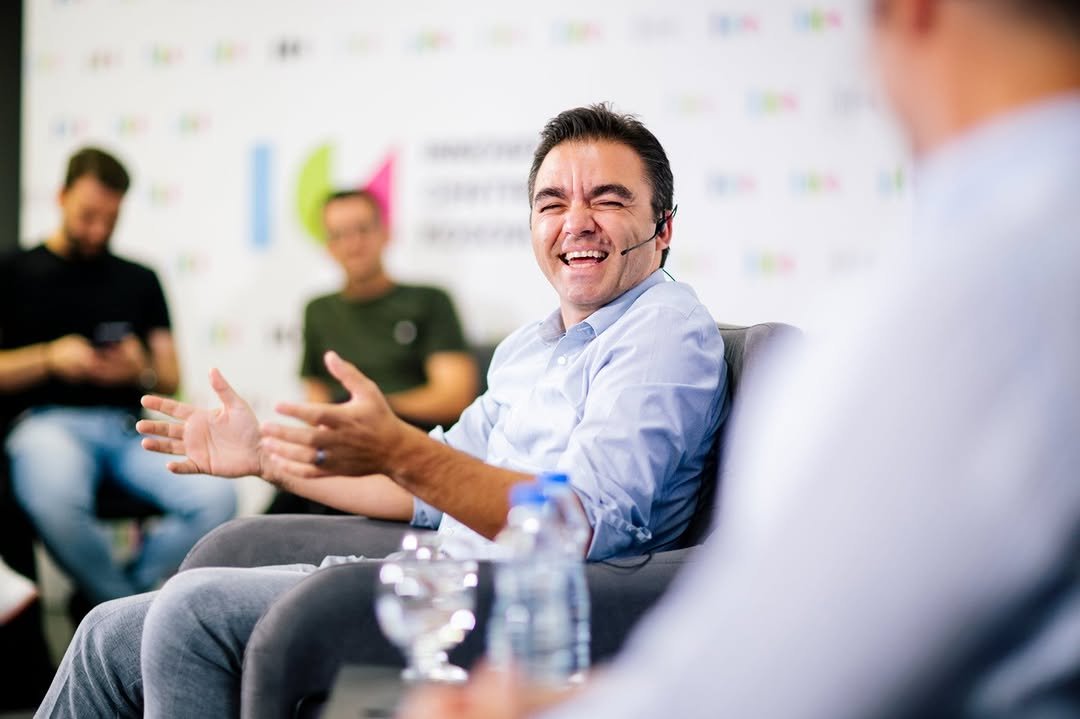
In this exclusive interview with Business Magazine, Mr. Komoni shares his personal story, the challenges of building a technology company in the United States, and his vision for the future of Artificial Intelligence in global supply chains.
Let’s start from the beginning. Tell us a bit about your background, because we know you moved to the United States at the age of 18 for your studies, and from there the story and success speak for themselves. Where and how did it all begin?
My beginnings were in Prishtina. I grew up there and, from a young age during high school, I mostly spent time with people who were two or three years older than me. They were interested in computers, programming, and business, and naturally that influenced me as well. I developed a desire to work very early in life. In the post-war period, when Kosovo was experiencing its first serious developments in media and technology, KTV and Vision television stations began broadcasting in September 2000. I joined them and, for around three to four months, worked first as a designer and later as a producer and editor, helping prepare various news materials. It was an intense experience during a period when everything was being built from scratch, and that was where I learned a great deal about how startups work in practice. Later, at the age of 17, almost 18, I moved to the United States for high school. After finishing school, I continued with university studies and eventually completed my master’s degree.
How was Tive born? How many employees did you start with and how many do you have today?
On the first day, it was just me. I started the company alone. The idea came from my background in engineering, specifically electrical engineering and, more precisely, telecommunications engineering. In the U.S., I worked in several startups, mainly designing radio chips. In short, I fell in love with frequencies. When I got married — my wife is Albanian — my father-in-law owned a transportation company with dozens of trucks and was constantly calling drivers asking, “Where are you?”
I told him, “I’ll build a device and connect it to a system so you’ll always know where your vehicles are.” That was how the idea began. I started the company alone and today we are around 310 people, if I am not mistaken.
310 employees sounds impressive. In how many countries does the company operate?
We have employees in 18 countries. Most are located in the United States, Kosovo, Norway, Mexico, South Africa, and China. In other words, we’re everywhere.
How does the Tive system work?
When you go into too much detail it can sound complicated, but in reality it’s very simple. Customers want to know where their goods are. Not only where they are, but also what condition they are in and how they are being handled.
What do we do? We send these trackers to customers.
For example, the customer receives the tracker and activates it with the press of a button. Whether the cargo contains strawberries, electronics, or televisions, the tracker is placed inside the truck or shipping container before it is sealed.
The tracker then transmits information showing where the shipment is and what is happening to it:
- Is it too hot?
- Is it too cold?
- Has it been dropped?
The device contains multiple sensors, including a light sensor.
If someone opens the trailer or container, the light sensor immediately detects it and alerts the customer in real time so they can react quickly.
How difficult was the journey, especially as an Albanian in America?
There are challenges because when you grow up in Kosovo or Albania — and I grew up in Kosovo during the war — and then move to a country where nobody knows you, you start with no network and no background that automatically creates trust. Nobody says, “Let’s invest in Krenar because he’s successful or because he comes from a certain place.” That trust doesn’t exist. The beginning was very difficult because it took me a long time to find my first investors.
What I learned is that confidence and self-awareness are crucial. We all happen to be born somewhere — Kosovo, Albania, Africa, America. That’s a lottery we don’t control. What happens next is in our hands, and we should never allow where we come from to limit us mentally. I have always viewed myself as equal to anyone in the world. Some people may have an easier path, others a harder one, but perseverance and ambition matter most. With investors, trust takes time to build. It’s not enough to say, “I will do it.” But if three or four months later you come back and say, “I accomplished what I told you I would accomplish,” then trust starts to form.
What value proposition does Tive bring to the market?
We have introduced many unique innovations. We were among the first to develop affordable 5G-enabled trackers. We created trackers without lithium batteries, making them more environmentally friendly. We were also the first to develop pallet trackers, after which competitors followed with similar solutions. On the software side, we have built an intuitive and easy-to-use platform that integrates seamlessly with transportation management systems and warehouses. Another thing that makes us unique is the accuracy of our location tracking technology.
As a founder, what qualities have contributed most to your success?
Two things stand out. The first was learning to listen to customers. When you start a company, you often believe your technology is the best in the world. But customers understand their own problems better than anyone else. The second is simple: Don’t give up. If you truly believe your solution is needed in the world, then the main reason a company fails is often because the founder quits.
How did you build such a strong team?
Naturally, we look for qualities most companies seek: hardworking, committed, precise people. But one quality that is difficult to detect and incredibly important is authenticity. People should bring their true selves to work. If Krenar comes to work, he comes as Krenar — not as one person in the office and another person elsewhere. That authenticity benefits both the individual and the company.
Was there a turning point that significantly impacted the company?
Creating the pallet tracker was a major breakthrough. Customers appreciated its environmental benefits and adoption increased rapidly. However, I believe Artificial Intelligence will be the next major growth driver. Today, moving goods from point A to point B requires countless phone calls, emails, and information exchanges. Most of these exist because people don’t know where the shipment is or what condition it’s in. Our data provides that truth in real time. AI agents that automate supply chain processes will need reliable data to function effectively. Our trackers provide exactly that data. We have already started integrating AI across our operations.
Internally, AI helps us build tools and dashboards that provide insights into customers and company performance.
Externally, we created Tive AI Labs, where we rapidly prototype solutions together with customers.
For example, if a truck carrying temperature-sensitive goods exceeds a certain temperature threshold, AI can automatically call the responsible person, explain the issue, and later confirm that the problem has been resolved.
Today, many companies still perform these tasks manually.
How does Tive continue innovating after all these years?
To succeed in technology, innovation is essential. A product does not necessarily have to be the first in the world. It simply needs to be the right product.
If you look at products such as the iPhone or AirPods, similar products existed before them, but they eventually became better and more aligned with customer needs. I believe our future is very clear. Wherever we go with hardware, I believe one day we won’t monitor just one million shipments but perhaps ten million or one hundred million shipments worldwide.
Combined with AI-driven automation across supply chains, that vision could become reality within the next three to five years.
How do you stay connected to customer needs?
Over the last three to four years we have become very good at listening to customers. Customers always express what they like or dislike somewhere — to account managers, customer support, or other channels. Many companies lose this information because it remains fragmented.
What we do is collect all customer feedback in one place. Our product teams then analyze, prioritize, and plan improvements accordingly.
What were some of the most difficult decisions you have made as CEO?
One of the most important moments came in 2019. We had very little money in the bank and only six employees. The decision I made was internal rather than financial: Even if the company failed, I would start all over again from the beginning. That commitment mattered more than anything else.
If you could start over, what would you do differently?
I would have listened to customers much earlier. I would have conducted more customer interviews from the very beginning. What took years to learn could perhaps have been achieved in nine months.
What advice would you give young Albanians who want to build something of their own?
There has never been a better time in human history to start a company, especially because of Artificial Intelligence. With cloud computing, ChatGPT, coding tools, and everything available today, this is an incredible era for building things. The second piece of advice is even more important: Your reason for building matters more than your idea. If your reason is superficial — for example, “I want to become rich” or “I want to make money” — then giving up becomes easy. The early months of building a company are extremely difficult. If your motivation is deep and meaningful, you won’t quit. The “why” is often more important than the idea itself.
How do you view the startup ecosystems in Albania and Kosovo?
There was tremendous momentum a few years ago as many companies began to emerge in both Albania and Kosovo. I believe one of the best models is the one we use at Tive. Employees should truly feel like part owners of the company. Every employee at Tive receives stock options. Employees in Kosovo, Norway, America — everyone owns part of the company. That creates a stronger sense of belonging and motivation. At the end of the day, people naturally work harder for something that is partly theirs.
One final curiosity: what does the name “Tive” mean?
I wanted a company name with four letters. Many of the world’s largest brands have four-letter names, like Nike or Audi. When I was working on the first tracker, words such as “active” and “intuitive” kept coming to mind. That’s how the name Tive was born.
Will Tive come to Albania as well?
I believe so. Kosovo was the first wave because I was born there and knew the environment very well. As the company grows, Albania and its ecosystem become increasingly important. The transformation that has happened in Albania in recent years is enormous — practically night and day compared to before.
The statistics confirm this as well. I believe the future is very bright.
0 comments