

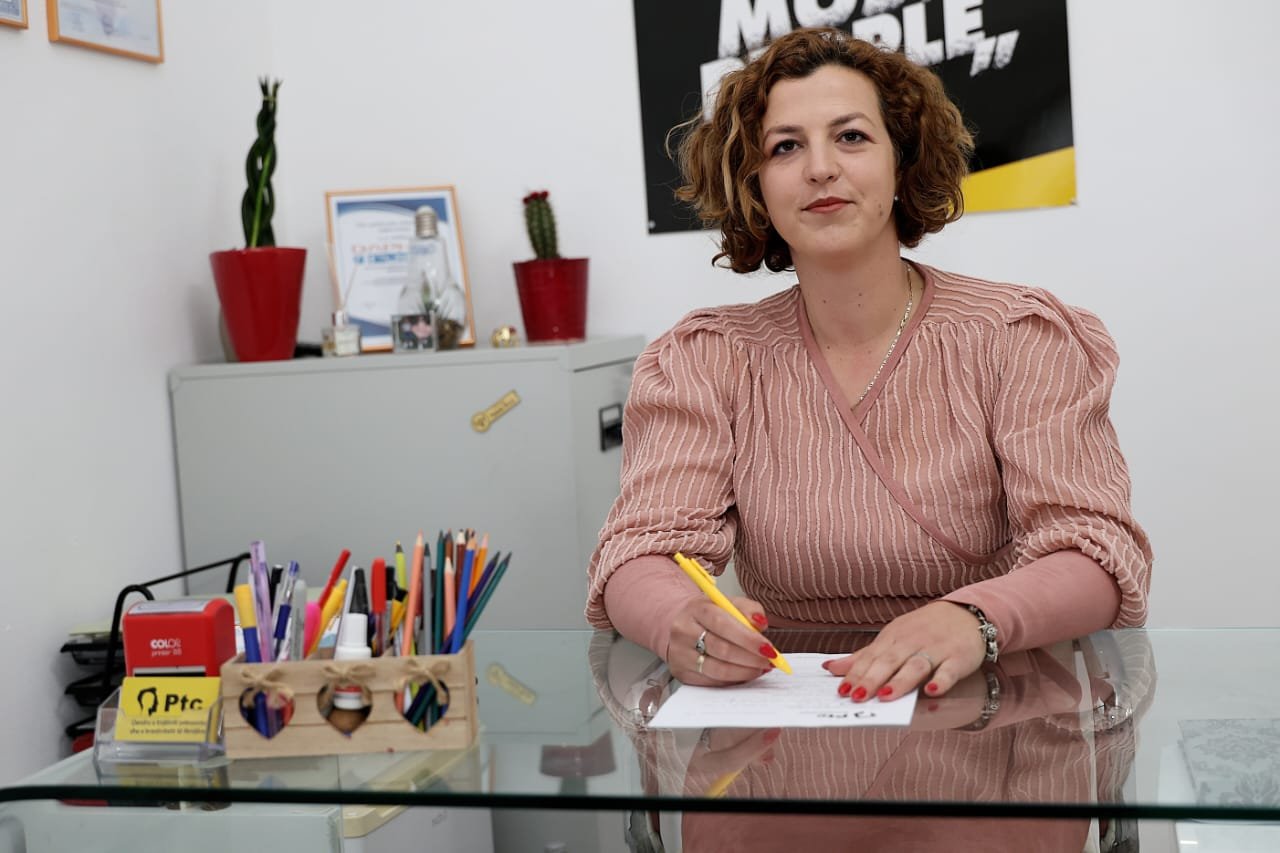
Some businesses are created to fill a gap in the market. Others are born from a personal experience so profound that it turns into a mission.
For Fabiola Elezaj, founder of PTC Center, everything began the moment she became a mother.
During the years she lived in a Nordic country, she experienced firsthand a model where family stood at the center of every social policy, where parents did not feel alone, and where seeking help was considered a responsibility rather than a weakness.
When she returned to Albania, she did not bring back merely a business idea. She brought back the conviction that Albanian families deserved the same level of support.
“PTC was not born from the desire to start a business, but from a personal story, a life experience, and a promise I made to myself,” says Elezaj.
Today, only a few years later, PTC has grown into one of the largest multidisciplinary centers in the country, offering 105 specialized services for children, parents, and adults.
Yet for its founder, success is not measured by the number of services or specialists.
“PTC was not born from the desire to start a business, but from a personal story, a life experience, and a promise I made to myself,” she repeats.
With an educational background, years of experience studying social phenomena, and professional expertise in psychological counseling, Elezaj had witnessed firsthand the challenges faced by Albanian families.
However, it was the period she spent living in a Nordic country that fundamentally changed the way she viewed family support.
“I did not only see functional institutions. I saw a culture where parents did not feel alone, where seeking help was considered responsibility rather than weakness, where early intervention was a priority, and where emotional well-being was treated with the same importance as physical health.”
As a new mother, she began asking herself questions that would later evolve into a mission.
“Why shouldn’t Albanian families have the same opportunities? Why should a parent in Albania feel alone when facing the challenges of parenthood?”
That was the moment the idea for PTC was born.
When she returned to Albania, Elezaj knew the journey would not be easy. Social stigma surrounding mental health, lack of information, and the tendency to delay seeking support were only some of the challenges she would face.
“My greatest success is not the number of services we have built. It is the trust Albanian families have placed in us.”
Starting with a small team and just 25 services, today PTC offers 105 specialized services for children, parents, and adults.
Yet according to her, the philosophy has remained unchanged.
“I believe every child deserves the opportunity to develop to their fullest potential. I believe every parent deserves to feel supported rather than judged.”
The Mission Is Not Therapy. The Mission Is Family
Throughout the conversation, Elezaj repeatedly returns to one central idea: the work does not begin and end with the child.
“My mission was never simply to provide therapy. My mission was to help families build healthier relationships with their children.”
For this reason, PTC has developed a multidisciplinary model where psychologists, therapists, educators, and specialists work together to view the individual as a whole person.
“We do not treat only the symptom. We analyze the individual’s history, family relationships, development, educational background, and emotional and social dimensions.”
At the heart of this philosophy is also the Parenting Academy, a project designed to empower parents through education and information.
“A child does not need perfect parents. A child needs parents who are willing to learn every day, who seek information, and who are not afraid to ask for help.”
“At PTC, We Do Not See Diagnoses. We See Stories”
When asked what differentiates PTC from other centers, Elezaj does not speak about technology or infrastructure.
“For me, a certificate is not the end of the journey. It is only the beginning.”
She explains that the team continuously receives training and that the greatest investment is made in people.
“An institution does not become great because of its walls or facilities, but because of the people working inside it.”
Perhaps the sentence that best summarizes her philosophy is this:
“At PTC, we do not see diagnoses. We see stories. We do not see problems. We see potential. We do not ask, ‘What is wrong?’ but rather, ‘What can we do together to help this family live better?’”
Among the many stories involving children and parents, Elezaj pauses at a particularly personal moment.
“The moment that touched me the most was PTC’s first anniversary. That was the day I realized that an idea which once existed only in my mind and heart had become a reality that had touched the lives of hundreds of families.”
Yet the greatest emotion still comes in her office.
“The moment I can tell a parent, ‘Your child no longer needs therapy,’ is one of the greatest victories a professional can experience.”
According to her, success is not measured by the number of sessions.
“We do not work so families stay with us for a long time. We work so that one day they no longer need us.”
The Greatest Investment Was Not Financial
Although building such a center requires significant resources, Elezaj says the most important capital was never financial.
“If you asked me what the greatest investment in PTC has been, I would not speak about finances. I would speak about trust.”
She explains that the center was built step by step through personal investment and a philosophy that places families before profit.
“I have never asked myself, ‘How much will we earn from this?’ My question has always been, ‘How many families will benefit from this?’”
For this reason, PTC also offers free orientation consultations.
“For us, a free consultation is not a lack of professionalism. It is proof that humanism is the foundation upon which PTC was built.”
A Vision Beyond a Single Center
When speaking about the future, Elezaj does not associate success with more facilities or more services.
“In five years, I want PTC to be recognized as an institution that has helped transform the way Albania understands parenting, education, and mental health.”
She aims to expand the center to 150 specialized services, but sees this as only one part of the larger vision.
“I want parents to no longer be afraid to seek help. I want early intervention to be viewed not as an exception, but as the standard.”
In the end, her message to every Albanian family is simple and direct:
“Do not wait for difficulties to become overwhelming before asking for help. Seeking help is not a sign of weakness. It is an act of love toward yourself, your child, and your family.”
And perhaps the sentence that best captures her philosophy is the one with which she concludes the interview:
“If, many years from now, someone asks me what my greatest success was, I will not speak about awards or numbers. I will smile and say: ‘My greatest success will be if PTC continues to live on as an institution that serves people even when I am no longer part of it.’”
0 comments